Understanding how these two hormones shape energy, recovery, and overall health - and why it’s not always just testosterone
Medical review status: no named clinician review is shown for this article. Read the medical review policy
For most men, the shift doesn’t happen overnight.
It builds quietly - energy begins to dip, recovery slows, and the body no longer responds the way it once did. At first, it’s easy to rationalize: age, stress, a demanding lifestyle. And more often than not, testosterone takes the blame.
But the reality is more nuanced.
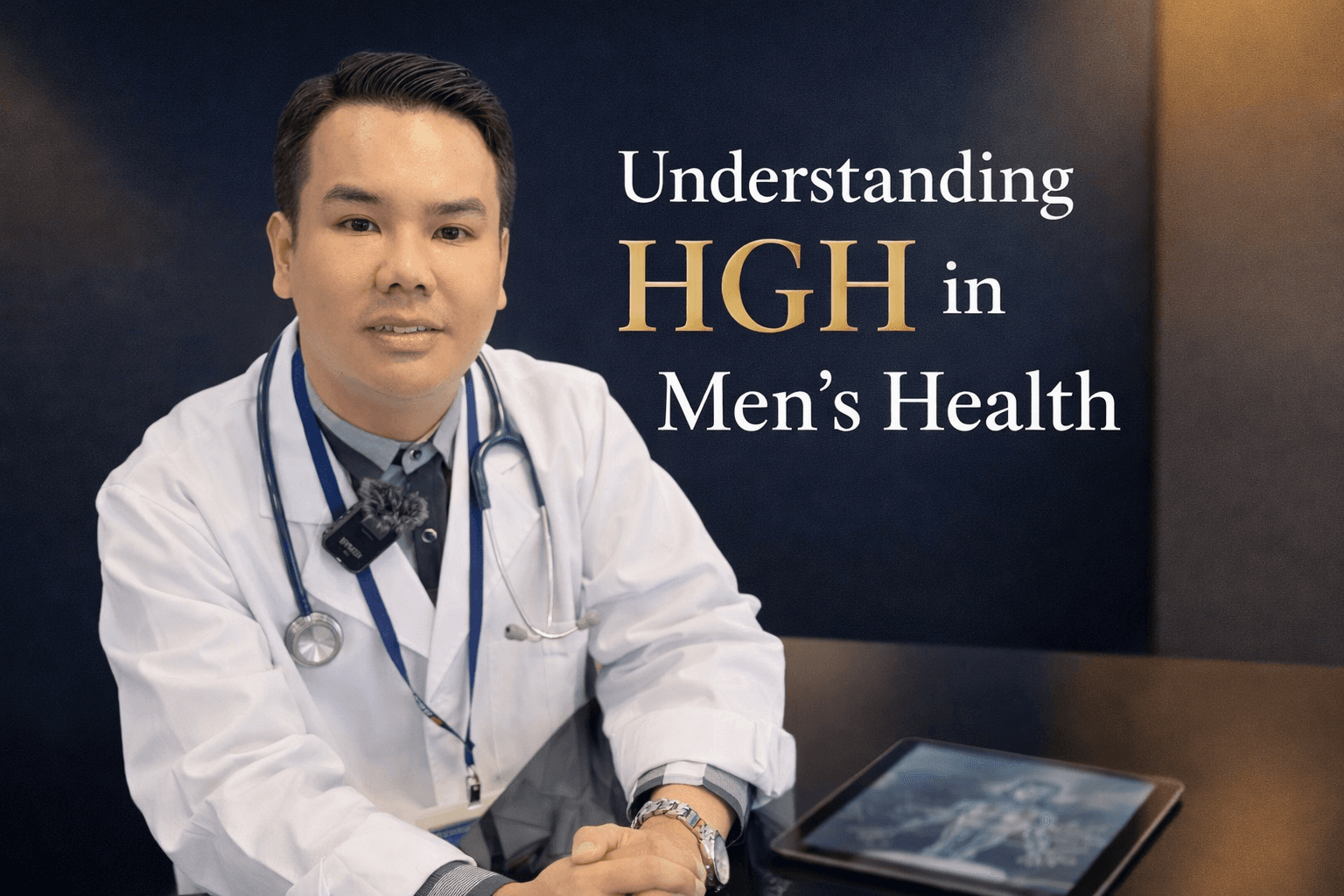
To understand what’s truly happening beneath the surface, we spoke with physicians specializing in hormone health.
From the fundamentals of HGH to its evolving role in modern clinical care, this conversation unpacks the questions many men think about - but rarely explore in depth.
More importantly, it offers a clearer perspective on the signals your body may be sending - and how to respond with clarity, context, and informed intent.
There’s a moment many men recognize - but rarely talk about. Workouts don’t hit the same. Recovery takes longer. Energy dips for no clear reason.
It’s often blamed on “getting older.” But beneath the surface, there’s a deeper shift happening - your hormones are changing.
At the center of it is Human Growth Hormone (HGH).
Produced by the pituitary gland, HGH acts as one of the body’s most importantregulators of repair, recovery, and physical performance.
It plays a key role in:
Rebuilding and repairing tissues
In short, HGH helps keep the body functioning like it did in its prime.
In your late teens and early 20s, HGH levels are at their peak - when your body recovers fast, builds muscle efficiently, and feels almost effortless.
But from around age 30, levels begin to drop - slowly, but consistently - by about1–2% each year.
By your 50s, you may be operating withas little as 20–40% of the HGH you once had.
The effects don’t show up overnight. They build quietly - and then suddenly feel familiar:
These changes are often accepted as inevitable. But they’re not just about age - they’re aboutwhat’s happening beneath it.
HGH isn’t just a “growth hormone.” It’s a cornerstone of how men maintain strength, energy, and resilience over time.
And understanding how it changes may be the first step toward taking control of how you age - not just how old you are.
It doesn’t happen overnight. But at some point, many men start to notice subtle shifts
Workouts feel harder. Recovery takes longer. Energy isn’t quite what it used to be.
It’s easy to call it “just aging.” But in many cases, your body may be signaling something deeper - like a decline in HGH.
The first signs are often physical - and easy to overlook:
For many men, the change is less visible - but more noticeable day to day:
It’s not just physical. Hormonal changes can also affect how you feel and think:
Some effects happen beneath the surface:
Here’s where it gets complicated.
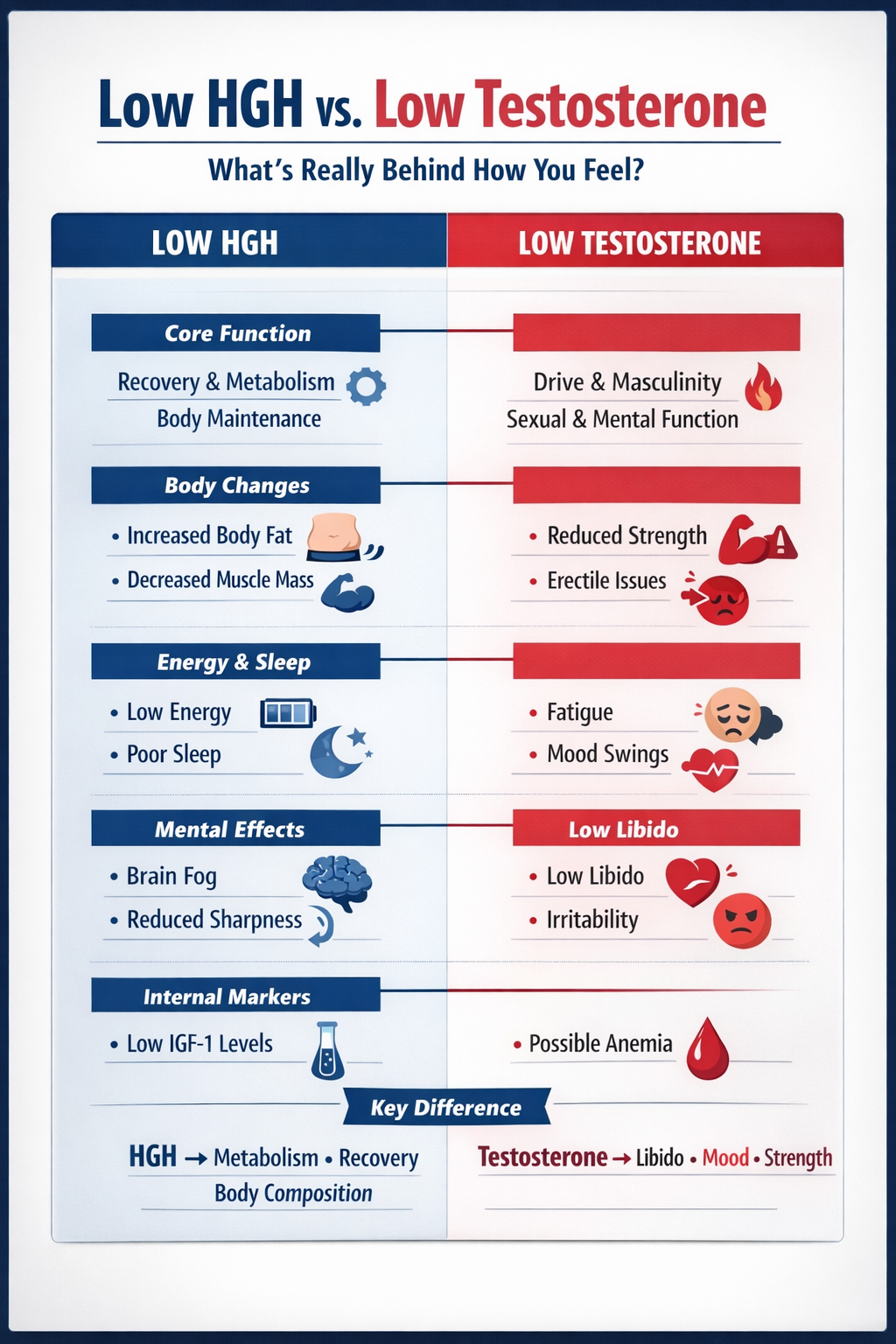
Many of these symptomsoverlap with low testosterone, making it difficult to tell the difference without proper testing.
That’s why guessing isn’t enough. Understanding your hormone levels is key to understanding what your body is really going through.
It’s one of the most common questions - and one of the most misunderstood.
When men start feeling “off,” it’s easy to assume it’s just testosterone.
But in reality, HGH and testosterone affect the body in very different ways.
The answer is yes - and it’s more common than you might think.
Some men experience both low HGH and low testosterone at the same time.
However, these are separate hormone systems, each requiring its own proper evaluation and diagnosis.
If something doesn’t feel right, don’t assume it’s just testosterone.
Because understanding the difference is the first step toward taking control of your health - accurately and effectively.
HGH has become one of the most talked-about hormones in men’s health. But with the hype comes confusion - and plenty of myths.
Here’s what most men get wrong.
It sounds appealing - but it’s not that simple.
Reality: HGH can help improve body composition and energy levels - especially in men who are truly deficient. But it doesn’t stop aging. And it certainly doesn’t turn back the clock.
This is one of the biggest misconceptions.
Reality: HGH isn’t about massive muscle gain. Its real role issupporting fat loss and recovery - not transforming your physique overnight.
In hormone therapy, more is never the goal -balance is.
Reality: Excess HGH can lead to unwanted effects, including:
Insulin resistance
They’re closely linked - but not interchangeable.
Reality: HGH acts as the signal. It stimulates the liver to produceIGF-1, which is responsible for many of the hormone’s metabolic effects.
It’s a promise you’ll see everywhere - pills, powders, natural boosters claiming to elevate your HGH levels.
It sounds simple. Almost too simple.
Reality: Most oral “HGH boosters” deliverlittle to no meaningful clinical effect.
They may look convincing on the label, but in practice, they rarely influence HGH in a way that translates into real, measurable results.
If your goal is better recovery, improved body composition, or sustained energy, relying on over-the-counter supplements is unlikely to get you there.
Real progress doesn’t come from marketing claims. It comes fromunderstanding your hormones - and managing them with precision.
For years, HGH has been associated with anti-aging hype. But in modern medicine, the narrative is evolving.
Today, the focus is shifting toward precision health, biomarker optimization, and long-term performance - not quick fixes.
At the center of this shift is a deeper understanding ofIGF-1 and growth pathways, which are now becoming key pillars in longevity science.
The future isn’t about pushing hormone levels higher it’s about keeping themwithin an optimal, individualized range.
By carefully adjusting IGF-1, clinicians aim to support:
This is where hormone therapy becomesdata-driven, not guesswork.
As men age,sarcopenia - the gradual loss of muscle - becomes a critical concern.
In clinically confirmed cases, treatment may include:
The goal isn’t enhancement. It’srestoring function and maintaining independence over time.
The next generation of men’s health is moving away from one-size-fits-all solutions.
Instead, it’s aboutpersonalized protocols, designed to maintain:
Not to reverse aging but to age with strength, clarity, and control.
Future clinical guidelines are becoming more precise and evidence-based:
Because in hormone optimization, precision always outweighs excess.
A growing shift in clinical practice is moving away from direct hormone replacement.
Instead, there is increasing interest inHGH secretagogues, including:
These compounds work by stimulating the body’s own pituitary gland, supporting a more natural and regulated hormonal response.
The future of HGH isn’t about chasing youth it’s about optimizing how the body functions over time.
And the difference between hype and real results comes down to one thing:precision medicine, guided by expertise.
####Dr. Thanathip Sunthara (Dr. Champ)
Physician in Hormone Health & Men’s Wellness
Dr. Thanathip Sunthara is a physician with extensive clinical experience in the management of male hormonal health and age-related conditions. His areas of expertise include andropause (low testosterone), menopause, erectile dysfunction, and anabolic steroid-induced hypogonadism.
With a patient-centered approach, Dr.Champ focuses on accurate diagnosis, individualized treatment planning, and long-term health optimization - particularly in men experiencing hormonal decline.
Over the past three years, he has treated hundreds of patients with low testosterone, with many reporting significant improvements in energy, physical performance,and overall quality of life.
Dr. Champ is fluent in both English and Chinese, allowing him to effectively communicate with a diverse international patient base.
Contact us : https://www.wellthymeclinic.com/
These are links included in the article content. They are not presented as a complete or independently verified reference list. Meaningful medical claims should also be checked against primary or authoritative sources.

Healthi-Life Longevity Center on the Hidden Signals of Aging - and Why the Best Time to Take Action Is Before You Feel Anything Is Wrong
AUG 26

For decades, longevity has been measured by a single number "how long we live." But today, a growing number of physicians and researchers believe there's a far more important question to ask not "how many years" we can...
JUL 8

Three Thai physicians explain what TRT really is, what it isn’t, and how to think about “normal” vs “optimal” testosterone without the bro science.
FEB 11