For decades, longevity has been measured by a single number "how long we live." But today, a growing number of physicians and researchers believe there's a far more important question to ask not "how many years" we can...
Medical review status: no named clinician review is shown for this article. Read the medical review policy
For decades, longevity has been measured by a single number "how long we live."
But today, a growing number of physicians and researchers believe there's a far more important question to ask not "how many years" we can add to life, but "how much life" we can add to those years.
This shift has brought increasing attention to the concept of healthspan - the years we remain healthy, active, independent, and free from major chronic disease. Rather than simply extending lifespan, modern preventive medicine is focused on helping people maintain their physical strength, cognitive function, and overall quality of life well into older age.
As longevity science continues to evolve, healthspan has become one of the defining goals of modern healthcare.
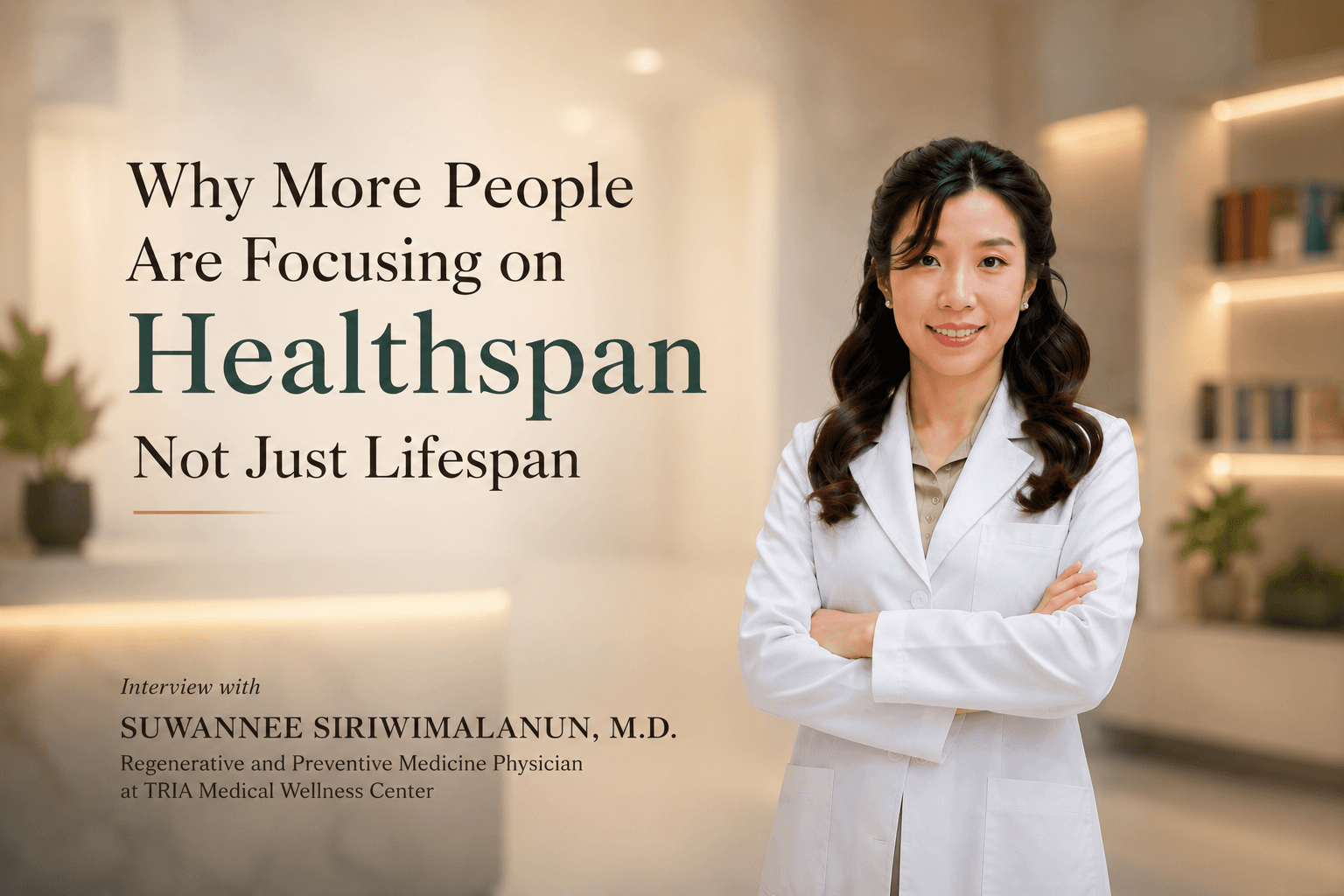
To better understand what healthspan really means, why some people remain remarkably healthy into their 70s and 80s while others experience decline much earlier, and what we can do today to age more successfully, Tiger Health spoke with Dr. Suwannee Siriwimalanun, Regenerative and Preventive Medicine Physician at TRIA Medical Wellness Center.
Drawing on evidence-based preventive medicine and the latest advances in longevity science, Dr. Suwannee shares practical insights into how everyday choices can shape not only "how long we live - but how well we live."
For decades, the conversation around longevity has focused on a single number: how long we live.But according to Dr. Suwannee Siriwimalanun, Regenerative and Preventive Medicine Physician at TRIA Medical Wellness Center, that question no longer captures what most people truly want from aging.
"Living longer is no longer enough," she explains. "The real goal is to remain healthy, independent, physically active, and mentally sharp for as many years as possible."
This is the fundamental difference between "lifespan" and "healthspan."
While lifespan simply refers to the total number of years we live, healthspan describes the number of years we spend in good health - free from major chronic diseases, physical disability, and cognitive decline. In other words, it's not just about reaching 90 or 100, but about still being able to enjoy life when you get there.
For much of modern medicine, the primary objective was to extend lifespan by diagnosing and treating disease. Medical advances have been remarkably successful in helping people live longer than previous generations.
Today, however, longevity medicine is asking a different question.
Instead of asking "How long will we live?", physicians are increasingly asking, "How well will we live?"
That shift reflects a broader change in how we think about aging. Rather than simply adding years to life, more people are now looking to add life to their years - maintaining the energy to travel, staying physically active, preserving cognitive function, and continuing to live independently well into their 70s, 80s, and beyond.
In Dr. Suwannee's view, this is exactly why healthspan has become one of the most important concepts in modern preventive medicine.
"The ultimate goal isn't simply to extend life," she says. "It's to help people live better for longer."
Why do some people remain energetic, mentally sharp, and fully independent well into their 70s or even 80s, while others begin experiencing fatigue, muscle loss, or chronic illness decades earlier?
According to Dr. Suwannee, the answer is rarely a matter of luck.
In longevity medicine, there is a well-known saying:
"Genetics loads the gun, but lifestyle pulls the trigger."
Although genetics certainly influence how we age, they account for only 20–25% of our longevity. The remaining 75–80% is shaped by lifestyle and environmental factors, many of which influence the way our genes are expressed through a process known as epigenetics.
"Whether we remain physically active, mentally sharp, and independent in our later years is largely the result of the choices we make every day," Dr. Suwannee explains.
In other words, healthy aging isn't something we're simply born with - it's something we build over a lifetime.
According to Dr. Suwannee, the foundation of a long and healthy life rests on the six pillars of Lifestyle Medicine : regular physical activity, nutritious eating, restorative sleep, effective stress management, meaningful social connections, and avoiding harmful substances such as smoking and excessive alcohol consumption.
These daily habits may seem simple, but when practiced consistently over decades, they have a profound impact on both lifespan and healthspan.
Another key factor is the body's ability to control chronic low-grade inflammation, a condition researchers now refer to as "inflammaging." Unlike the temporary inflammation that helps the body heal after an injury, inflammaging develops quietly over many years and is now recognized as one of the major drivers of biological aging.
People who experience premature physical or cognitive decline often share common underlying issues that may have been silently affecting their health for decades. These include chronic stress, metabolic dysfunction such as insulin resistance, poor sleep quality, and a sedentary lifestyle that accelerates the loss of muscle mass and strength - a condition known as sarcopenia.
The good news, Dr. Suwannee says, "is that many of these factors are modifiable. Aging is inevitable, but how we age is influenced far more by our daily habits than most people realize."
One of the biggest misconceptions about health is that if your annual check-up looks normal, you must be healthy.
According to Dr. Suwannee Siriwimalanun, that assumption couldn't be further from the truth.
In preventive and longevity medicine, physicians aren't simply looking for disease - they're looking for the earliest signs that the body is beginning to lose its resilience.
We don't wait for a diagnosis, Dr. Suwannee explains. Instead, we look for what we call subclinical functional decline - the stage where you're not sick yet, but your body is no longer functioning at its full potential.
This "gray zone" often develops silently over many years, making it easy to overlook. Yet it is during this period that early intervention can have the greatest impact on long-term health.
One of the first warning signs is persistent fatigue without an obvious cause. If you regularly wake up feeling exhausted despite getting seven or eight hours of sleep, it may indicate that your mitochondria - the tiny structures responsible for producing energy inside your cells - are no longer functioning efficiently.
Another common but often overlooked symptom is "brain fog." Difficulty concentrating, forgetting names, or feeling mentally slower than usual may not simply be a consequence of a busy lifestyle. Instead, these subtle cognitive changes can reflect early neuroinflammation or underlying metabolic dysfunction affecting brain health.
Physical performance can also reveal important clues.
If carrying groceries, climbing stairs, or completing your usual workout suddenly feels more difficult than it used to, it may signal a gradual decline in muscle quality and metabolic reserve. Rather than being an inevitable consequence of aging, these changes often indicate that the body's resilience is beginning to diminish.
Dr. Suwannee also highlights "poor stress resilience" as an early marker of declining healthspan.
Feeling overwhelmed more easily, becoming unusually anxious or irritable, or struggling to recover emotionally from everyday stress may reflect an imbalance in cortisol - the body's primary stress hormone - which plays a critical role in overall health and longevity.
Recovery time is another important indicator.
"If your body takes noticeably longer to recover from a workout, a minor illness, or even one poor night's sleep, it's often a sign that your cellular repair mechanisms are becoming less efficient," she says.
While many people dismiss these symptoms as "just getting older," Dr. Suwannee believes they should instead be viewed as valuable early warning signals.
"The encouraging news," she adds, "is that these changes often appear years before disease develops. By recognizing them early and making targeted lifestyle changes, we have a real opportunity to slow biological aging, preserve function, and extend our healthspan."
With so much information about longevity - from supplements and hormone therapy to wearable technology and genetic testing - it's easy to assume that living a longer, healthier life requires complex interventions.
Dr. Suwannee believes the opposite is true.
"If you're looking for the highest return on investment for your healthspan," she says, "the most powerful place to start is with your everyday habits."
Rather than chasing the latest longevity trend, she encourages patients to build their lives around what is known as the "Six Pillars of Lifestyle Medicine" a science-backed framework that has consistently been shown to improve both lifespan and healthspan.
Nutrition remains one of the most powerful tools for slowing biological aging.
Dr. Suwannee recommends moving away from ultra-processed foods and instead focusing on a whole-food, plant-predominant diet rich in fiber, healthy fats, and high-quality nutrients. Keeping blood sugar levels stable and minimizing frequent insulin spikes can significantly reduce chronic inflammation and metabolic dysfunction - two major drivers of accelerated aging.
No medication can replace the benefits of regular movement.
According to Dr. Suwannee, an effective exercise routine should combine cardiovascular training with resistance training. While cardio supports heart health, preserving muscle mass is equally essential. Muscle is not only critical for strength and mobility but also serves as one of the body's most important metabolic organs, protecting against frailty and chronic disease as we age.
Sleep is far more than simply getting enough hours in bed.
During deep sleep, the brain activates its glymphatic system - a natural cleansing process that removes cellular waste while repairing tissues and restoring hormonal balance. Poor sleep, especially over many years, accelerates biological aging, disrupts metabolism, and negatively affects memory, concentration, and overall cognitive performance.
For most adults, Dr. Suwannee recommends aiming for seven to eight hours of uninterrupted, high-quality sleep each night.
Chronic stress quietly affects almost every system in the body.
Persistently elevated cortisol levels can break down muscle tissue, promote visceral fat accumulation, weaken the immune system, and accelerate aging. Even small daily practices such as mindfulness, breathing exercises, meditation, or simply creating moments of genuine rest can help shift the nervous system from a constant "fight-or-flight" response into a restorative state where healing and recovery can occur.
Healthspan isn't determined by biology alone.
Humans are naturally wired for connection, and research continues to show that chronic loneliness and social isolation can be as harmful to long-term health as smoking.
Maintaining close relationships with family, friends, and supportive communities not only improves emotional well-being but also reduces inflammation and helps preserve cognitive function as we grow older.
Finally, protecting healthspan also means reducing unnecessary exposure to substances that silently damage our cells.
This includes avoiding tobacco, limiting alcohol consumption, and being mindful of environmental pollutants such as PM2.5, heavy metals, and microplastics. While these exposures may seem unavoidable in modern life, minimizing them whenever possible can help protect hormonal health, reduce inflammation, and slow the biological aging process.
Ultimately, Dr. Suwannee emphasizes that there is no single "longevity secret."
Healthy aging is the result of consistently making better choices - day after day, year after year.
"The small decisions we make every day," she says, "are often far more powerful than any breakthrough treatment when it comes to extending both lifespan and healthspan."
Suwannee Siriwimalanun, M.D. is a Regenerative and Preventive Medicine Physician at TRIA Medical Wellness Center, specializing in longevity medicine, healthy aging, and disease prevention. She earned her Doctor of Medicine from Chulalongkorn University, followed by a Master's degree in Anti-Aging and Regenerative Medicine. Board-certified in Preventive Medicine (Public Health), she is currently pursuing a Ph.D. in Stem Cell Biology and Technology at Thammasat University, with a research focus on advancing regenerative medicine and healthy longevity.
A Urologist's Perspective on Modern Men's Health Care For many men, health only becomes a priority when something starts to feel wrong. But what if the signs appear long before the symptoms?
SEP 16

Healthi-Life Longevity Center on the Hidden Signals of Aging - and Why the Best Time to Take Action Is Before You Feel Anything Is Wrong
AUG 26
Understanding how these two hormones shape energy, recovery, and overall health - and why it’s not always just testosterone
APR 8