
Today’s accomplished men aren’t just counting their money; they’re counting their healthy years ahead. Medical tourism for men is part of a larger shift in lifestyle and priorities.
Medical review status: no named clinician review is shown for this article. Read the medical review policy

Picture a successful 45-year-old executive taking a long weekend not for a golf trip, but to get a health tune-up in Bangkok. He returns with a sharper hairline, renewed energy, and a resolve to live longer. This scenario is becoming increasingly common. Across the globe, men in their 40s and beyond are embracing medical tourism as a route to longevity, vitality, and personal transformation. Instead of typical beach vacations, these professionals are flying to health hubs – especially in Thailand and Asia – to combine world-class medical care with leisure. It’s a confident, modern approach to aging: why settle for “growing old gracefully” when you can proactively invest in feeling younger? Globally, medical tourism is booming (over $31 billion in 2024), and Asia is leading the charge. Thailand alone recorded about2.5 million medical tourists in 2018 and commands nearly48% of the ASEAN medical & wellness tourism market. Men are a big part of this trend – seeking everything from testosterone therapy to hair restoration under the umbrella of a rejuvenating getaway.

Why are Asia and Thailand such magnets for health-focused travelers?Cost and quality. The region offers cutting-edge treatments at a fraction of Western prices (a knee replacement in Thailand might cost one-fifth of the U.S. price) without sacrificing quality. Hospitals like Bangkok’s Bumrungrad have premium wellness centers tailored to international patients, blendingmodern medical care with spa-like wellness. It’s medical tourism 2.0 – not just surgeries, but comprehensive health optimization packages. Thailand’s rich culture, hospitality, and natural beauty also mean you can recover on a tropical beach or meditate at a mountain retreat. Small wonder Asia-Pacific has emerged as a key hub for advanced procedures; countries likeThailand, India, and South Korea are now go-to destinations for hair transplants and anti-aging therapies. Even historically popular spots like Turkey (famous for hair transplants, treating ~700,000 foreign patients in 2019) are facing competition from Asia’s rise. For the globe-trotting man with disposable income, a trip to Asia offers a two-for-one: a vacation and a vitality boost.
One of the biggest draws in this male-focused medical travel boom istestosterone replacement therapy (TRT) and related hormone treatments. As men hit their 40s and 50s, testosterone levels dip – and interest in remedies soars. In recent years, TRT has “exploded” in popularity, with prescriptions climbing from about 7.3 million in 2019 to over 11 million in 2024. This surge reflects a broader cultural shift: men are increasingly proactive about treating fatigue, low libido, and diminished drive, viewing hormone optimization as a path to longevity. Clinics in Thailand, for example, cater to this demand by offering executive health checkups and personalized hormone programs, often at lower costs than in the West. While doctors caution that TRT isn’t a magic youth serum and carries some risks, the allure of feeling decades younger is strong. For many health tourists, the equation is simple –more energy and muscle, less hassle. They can get thorough lab work, consultations, and a tailored hormone plan abroad in a wellness-focused setting, then return home feeling revitalized. It’s medicine meets luxury: an IV vitamin drip in the morning, sightseeing in the afternoon.
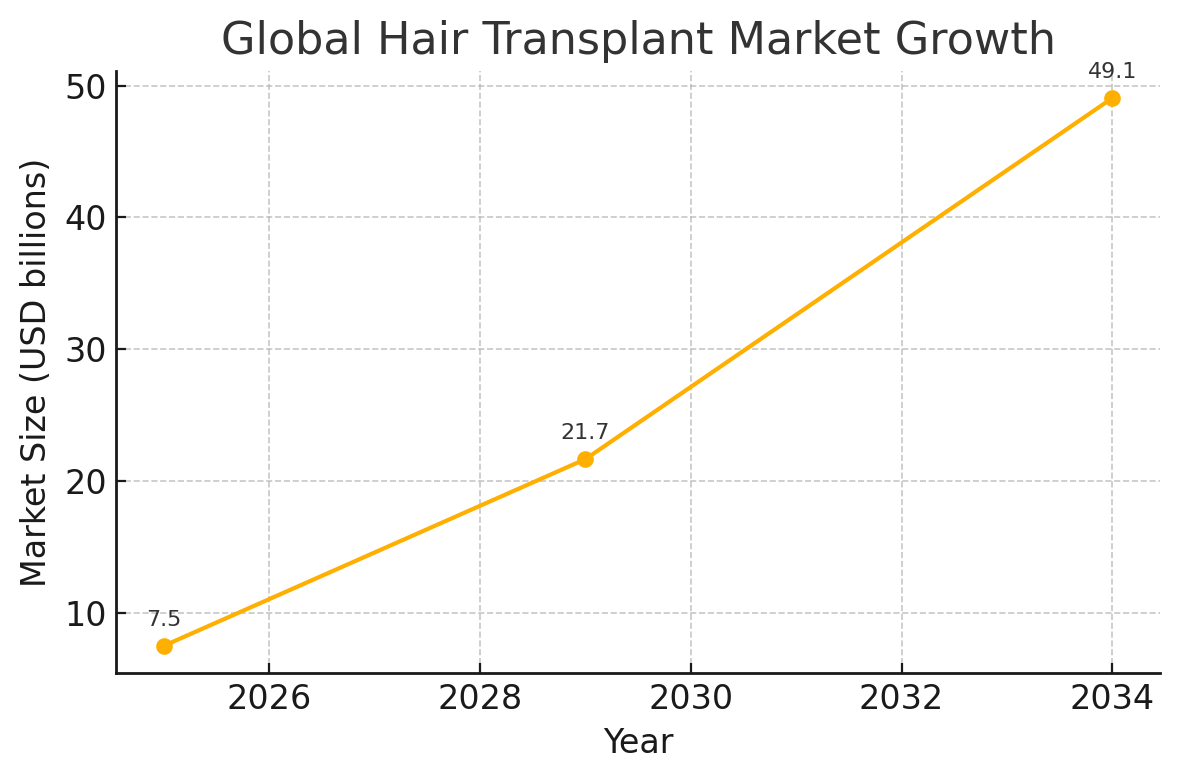
Perhaps nothing signals “personal transformation” like restoring a full head of hair. Hair transplant surgery has become a global phenomenon, largely driven by men seeking a confidence boost. The market for hair restoration is skyrocketing – valued around $7 billion in the mid-2020s and projected to reach roughly $49 billion by 2034.
Chart: Global hair transplant market size is on a steep rise, expected to grow several-fold from 2025 to 2034. This growth is fueled by technological advances (like virtually scar-free FUE techniques and even robot-assisted surgeries) and by sheer demand from aging consumers. Notably, over 80% of hair transplant patients are male, and many are willing to travel for the right mix of price and expertise. Asia has become a hotspot: Bangkok and Seoul host renowned hair clinics, while India’s expanding medical tourism sector serves ~2 million foreign patients annually (up from 700,000 in 2019), many seeking cosmetic procedures. These trips are often dubbed “hair holidays” – you fly in for a few days, get the procedure, recover by the pool, and fly back looking younger. The stigma around baldness is giving way to an attitude of empowerment: why not fix it if you can? For the 50-year-old manager who’s spent years lamenting his receding hairline, a transplant abroad offers a real chance at turning back the clock on appearance and confidence.
Beyond the headline-grabbing fixes like hair and hormones, a quieter revolution in health optimization is underway. Men with means are embracing a**“wellness lifestyle”** – incorporating preventive and regenerative therapies into travel. IV therapy clinics are a prime example. Once used mainly for hospital patients,IV vitamin drips are now a trendy wellness service, offered in high-end clinics from Bangkok to Bali. These infusions promise everything from instant hydration after a long flight to immune system boosts and hangover cures. The global IV hydration therapy market, while niche, is expected todouble from about $2.7 billion in 2024 to $5.8 billion by 2034 as these services become mainstream in spas and resorts. It’s not uncommon to see businessmen on layover getting a quick B12 drip or**“executive stress” IV cocktail**.
More broadly, wellness tourism – think yoga retreats, detox spas, and holistic health resorts – has become a massive industry riding on the pursuit of longevity. Globally,wellness travel is a trillion-dollar market set to nearly double by mid-next decade.
Chart: Global wellness tourism market is steadily growing, projected to roughly double from 2025 to 2035. Asia, again, is at the forefront, with Thailand seeing its wellness tourism spending double from 2022 to 2023 amid a post-pandemic health kick. For 40+ men, these wellness-focused trips are less about pampering and more aboutrejuvenation. They might entail meditation sessions at a mountainside retreat, herbal medicine workshops, or high-tech health assessments – all designed to extend healthspan (living healthier for longer). The key is that these experiences align with personal transformation goals: returning home not just relaxed, but tangibly healthier.
Today’s accomplished men aren’t just counting their money; they’re counting their healthy years ahead. Medical tourism for men is part of a larger shift in lifestyle and priorities. With ample disposable income, these individuals are saying “why wait?” and proactively seeking out the best the world has to offer for their well-being. Whether it’s testosterone therapy in a Bangkok clinic, a hair transplant in Seoul, or a week at a Phuket wellness resort, the message is clear: taking charge of one’s health and vitality is the ultimate investment. This trend, with Thailand and its Asian neighbors at its heart, underscores a modern ethos – that feeling youthful and strong is as much a reward of success as a sports car or luxury watch. In the Tiger Health era, hopping on a plane for abetter body and a sharper mind is not indulgence; it’s smart strategy. And for the men leading this movement, the ROI is measured in confidence, longevity, and quality of life. They’re redefining midlife as a time of peak performance, with a little help from a new kind of travel itinerary – one where “vacation” and “transformation” go hand in hand.