
What HYROX Can Teach Every Active Man About Recovery, Performance, and Longevity Over the past few years, HYROX has become one of the fastestgrowing fitness competitions in the world.
Medical review status: no named clinician review is shown for this article. Read the medical review policy
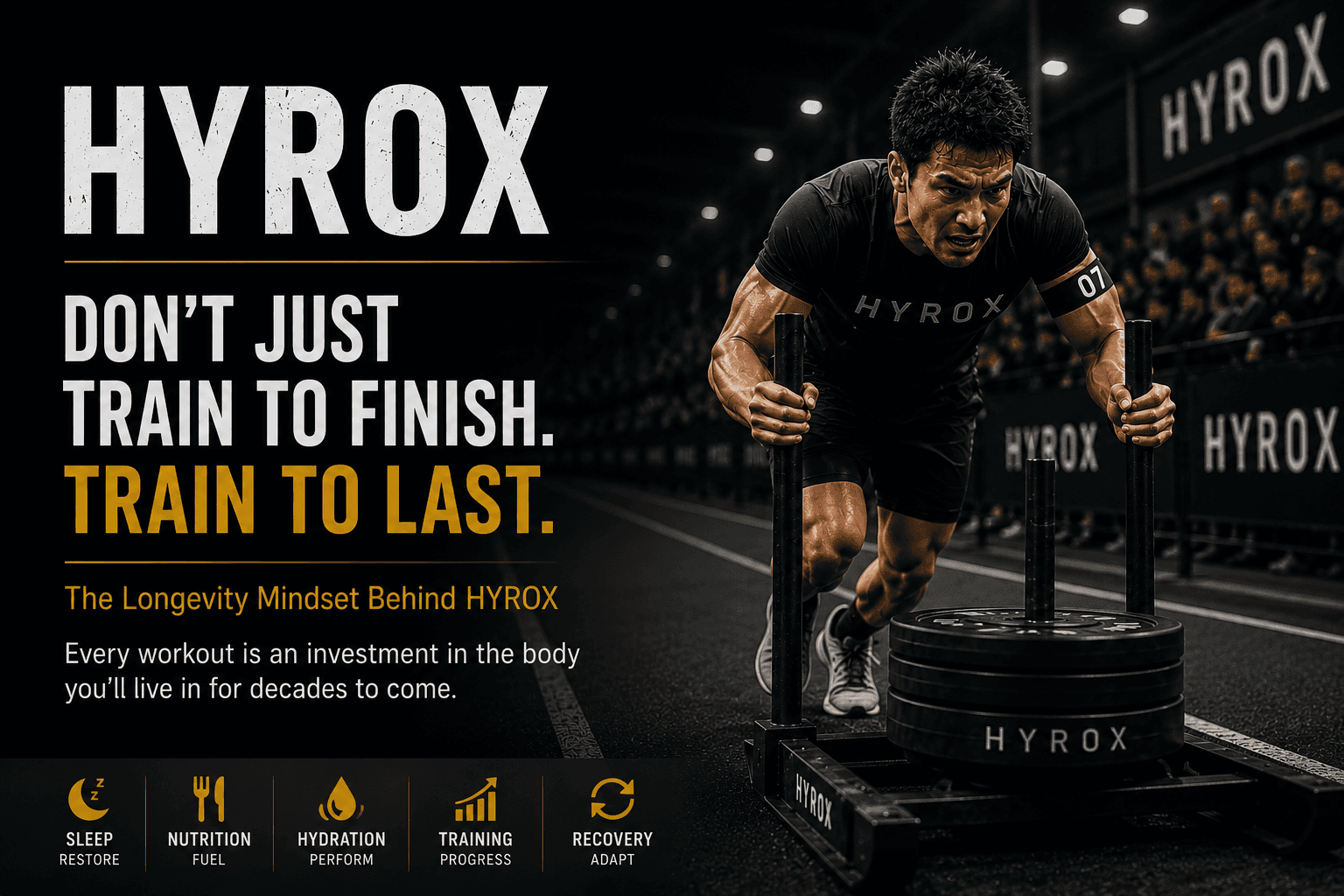
What HYROX Can Teach Every Active Man About Recovery, Performance, and Longevity
Over the past few years, HYROX has become one of the fastest-growing fitness competitions in the world. What began as a niche endurance event has evolved into a global movement, attracting everyone from elite athletes to weekend warriors, entrepreneurs, busy professionals, and men in their 40s and 50s looking for a new challenge.
But perhaps HYROX's greatest impact isn't the race itself.
It's changing the conversation around what it really means to be fit.
For decades, fitness culture rewarded intensity - more miles, heavier lifts, longer training sessions, and the ability to push through fatigue. Recovery was often treated as an afterthought, something reserved for professional athletes or people coming back from injury.
Today, that mindset is beginning to shift.
Athletes are no longer asking only, "How hard should I train?" They're also asking, "How well am I recovering?"
And according to sports science, that question may be just as important.
One of the biggest misconceptions in fitness is that muscles become stronger while you're exercising.
They don't.
Training places stress on the body. Recovery is when adaptation happens.
Every workout creates microscopic muscle damage, depletes energy stores, and challenges multiple physiological systems. During recovery, your body repairs those tissues, restores glycogen, and gradually adapts so it can better handle the next training session.
Sports medicine researchers describe this as the balance between training load and recovery. Improvements in strength, endurance, and performance occur only when sufficient recovery follows appropriate training stress. Without that balance, progress can plateau or even reverse.
This principle forms the foundation of modern athletic performance, whether you're preparing for HYROX or simply trying to stay healthy as you age.
When people hear the word "recovery," many immediately think about ice baths, massage guns, compression boots, or infrared saunas.
Those tools may have a role.
But they aren't where recovery begins.
According to recommendations from the American College of Sports Medicine (ACSM) and the International Olympic Committee (IOC), the fundamentals remain remarkably simple:
Everything else builds on that foundation.
Without these basics, even the most expensive recovery gadgets are unlikely to compensate.
Many recreational athletes are willing to spend hundreds of dollars on new running shoes or wearable technology.
Yet they routinely sacrifice sleep.
Research consistently shows that sleep plays a central role in muscle repair, hormone regulation, immune function, cognitive performance, and motor learning.
Consensus recommendations published in the British Journal of Sports Medicine suggest that insufficient sleep can impair reaction time, decision-making, strength, endurance, and increase the risk of illness and injury.
In other words, if you're training hard but sleeping poorly, you're limiting your body's ability to adapt.
One of the most overlooked concepts in sports science is that the body doesn't distinguish between different sources of stress.
A demanding workout.
A long workday.
Poor sleep.
Business travel.
Family responsibilities.
Psychological stress.
From a physiological perspective, they all contribute to your total stress load.
This is why two athletes following the exact same training plan may recover very differently.
It's also why recovery isn't just about muscles.
It's about managing your body's overall capacity to adapt.
Many active men believe that if four workouts per week produce results, six or seven must be even better.
Unfortunately, that's not how adaptation works.
When recovery fails to keep pace with training demands, the body begins sending subtle warning signs:
These symptoms don't necessarily mean you're training too much.
Often, they mean you're recovering too little.
Recognizing those signals early may prevent weeks - or even months of lost training.
At its core, HYROX isn't simply testing strength or endurance.
It's testing your ability to balance both.
Success doesn't come from being the strongest athlete in the room.
Nor does it belong exclusively to the fastest runner.
The athletes who consistently perform well are often those who train intelligently, recover consistently, and stay healthy enough to keep showing up.
In many ways, HYROX reflects a broader shift in modern health.
People are becoming less interested in simply looking fit.
They're becoming more interested in building bodies that remain strong, resilient, and capable for decades.
Perhaps that's why HYROX resonates with so many adults in their 30s, 40s, and beyond.
It's not just about crossing a finish line.
It's about maintaining muscle mass, cardiovascular fitness, mobility, and resilience - the very qualities that research increasingly associates with healthy aging.
The goal isn't simply to perform well this season.
It's to remain active, independent, and physically capable for the next twenty or thirty years.
That's also the philosophy behind longevity medicine.
Not simply extending lifespan.
But extending healthspan the years of life spent in good health.
But its biggest lesson has little to do with sled pushes or wall balls.
It reminds us that fitness isn't measured solely by how much stress we can tolerate.
It's measured by how well we recover from it.
Because the ultimate goal isn't just to finish your next race.
It's to still be training - strong, healthy, and injury-free many years from now.