

Hair Transplant Post-Op Recovery: What Actually Matters in the First 30 Days
Hair transplantation is not cosmetic vanity. For many men, it is a strategic intervention in confidence, identity, and long-term self-image.

Why Post-Op Recovery Determines Your Result
A hair transplant is not finished when the last graft is placed. Surgery creates the potential, but recovery determines whether that potential is realized.
Most disappointing outcomes are not caused by poor surgical technique. They are caused by avoidable mistakes in the first two weeks. Rubbing grafts, sleeping badly, exercising too early, or using the wrong products can permanently compromise results. This is why post-operative care matters as much as surgeon selection.
For men focused on appearance, confidence, and long-term vitality, recovery discipline is where outcomes are decided.
The One Rule That Overrides Everything Else
The single most important instruction after a hair transplant is simple.
Do not rub off your grafts.
Everything else is secondary.
Grafts are most vulnerable during the first three days. During this window, accidental contact, scratching, rubbing, or pressure can dislodge follicles before they anchor. After day three they become more stable, but careless handling can still cause damage.
The real challenge is not understanding this rule, but remembering it while numb, swollen, tired, and half asleep. Most patients instinctively touch their scalp without realizing it. This is why sleep setup and habit control matter more than complex instructions.
Pain Control and Medications
Once anesthesia wears off, mild soreness is normal. Most patients manage comfortably with acetaminophen such as Tylenol or Tylenol Extra Strength. Stronger pain medication may be prescribed but is rarely necessary.
A short course of antibiotics is commonly used to reduce infection risk. Topical antibiotic ointment is applied only to the donor area, never to the recipient area where grafts were placed.
This distinction is critical. The recipient area must remain undisturbed. Over-treating it can do more harm than good.
Sleeping Position and Swelling Control
Sleep is one of the most underestimated risk factors in recovery.
For the first two nights, sleeping with the head elevated at roughly a 30 to 35 degree angle is recommended. This reduces swelling and lowers the chance of rolling onto grafts. Recliners work well. Pillows can work if arranged carefully.
A neck pillow is strongly recommended. It limits head movement during sleep and helps prevent accidental graft contact. A towel placed over pillows protects bedding from minor donor-area bleeding, which is normal during the first one to two days.
Swelling often peaks several days after surgery, especially if the hairline or temples were treated. Swelling may travel down the forehead and into the eyelids before resolving. This is expected and temporary.
Physical Activity and Exercise Timing
Physical exertion too early increases swelling, sweating, and graft risk.
No exercise for the first six days.
Light activity can resume after day six. Full workouts, including weight training, should wait until two weeks post-op. Swimming, whether in a pool or the ocean, should wait until at least three weeks.
These timelines are not arbitrary. They reflect the biological anchoring of grafts and the risks created by friction, pressure, and contamination.
Headwear and Sun Exposure
Patients are usually sent home with a loose surgical cap. While open air is preferred for healing, a cap can be used carefully when necessary.
Putting on or removing a cap must be done gently. Always lift it up and away from the scalp. Never slide it across the grafted area.
Baseball caps and fitted hats should wait until two weeks, once scabs have fallen off and healing has progressed.
Direct sun exposure should be avoided for the first two weeks. Hats are acceptable protection if worn correctly.
Cleaning the Scalp: Donor Area vs Recipient Area
The donor area and recipient area follow different rules.
The donor area is treated more conventionally. Ointment is applied for the first five days. Light bleeding may occur and is completely normal.
The recipient area requires restraint.
On post-operative day one, a spray solution is applied every 30 to 60 minutes to keep grafts hydrated. This solution mimics the environment the grafts were stored in during surgery.
From days two to five, gentle cleansing is done using warm water and diluted baby shampoo poured over the scalp. No rubbing and no pressure.
From day six onward, normal showering can resume. At this point, patients begin gently working out scabs using a lathering motion, not scrubbing. By day fourteen, all scabs should be gone.
Facial transplants such as eyebrows or beard grafts require extra caution due to graft angle. These areas should remain dry until day six.
Hair Shedding and Regrowth Timeline
One of the most common sources of anxiety after surgery is shedding.
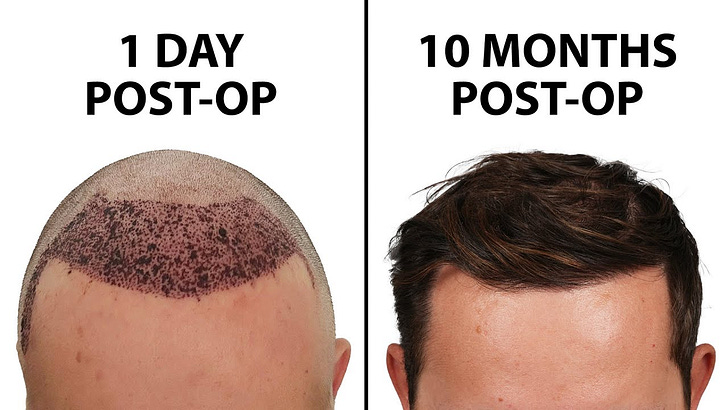
Transplanted hairs often fall out between one and five weeks after surgery. This is normal. These are hair shafts, not follicles. The follicles remain intact and dormant before re-entering the growth cycle.
New growth typically begins around four months post-op. Hair grows at approximately half an inch per month. Most visible results appear between eight and twelve months, with final maturation sometimes taking up to eighteen months.
Patience is part of the process.
Recommended Reading:
Minoxidil, Haircuts, and Styling
Topical minoxidil is usually paused for two weeks after surgery to allow scalp recovery. It can then be reintroduced gradually if there is no irritation. Oral minoxidil does not need to be stopped.
Haircuts in the donor area can be done as early as five days post-op. The recipient area should wait at least three weeks.
Combs can be used lightly after five days, but must never be dragged across the scalp. Styling is allowed with caution. Aggression is not.
Hair coloring should wait three weeks.
Recommended Reading:
Healing Accelerators and When to Be Careful
Low-level laser therapy can be used early if the device does not touch the scalp. Helmet-based devices should wait until day six.
PRP is often combined with hair transplantation and can also be repeated at intervals such as three, six, and nine months to enhance outcomes.
Small pimples can appear during healing. Warm compresses and topical antibiotic ointment usually resolve them. Do not pick. If they worsen or persist, medical guidance is required.
Warning Signs That Require Medical Attention
Serious complications are uncommon but possible.
Concerning signs include increasing pain, excessive swelling, persistent bleeding, skin darkening, fever, shortness of breath, or chest pain. These require immediate contact with the clinic or emergency services.
The Tiger Health Takeaway
Hair transplantation is not cosmetic vanity. For many men, it is a strategic intervention in confidence, identity, and long-term self-image.
Surgery sets the stage. Recovery determines the outcome.
Men who approach post-operative care with the same discipline they apply to training, nutrition, or career consistently achieve better results. The rules are simple. Execution is everything.