

A Hair Transplant Is a Plan Not a Procedure
Why long-term strategy, not just surgical technique, defines real results

Hair transplant isn’t just a procedure anymore it’s a strategy.
From pre-surgical planning to long-term maintenance, the difference between “good” and “great” results often comes down to what happens before and after the surgery.
In this interview, we explore what really matters: timelines, myths, shock loss, and the treatments that actually work.
Because restoring hair is one thing
making it last is another.
If a patient is visiting Malaysia specifically for FUE, what is the typical timeline from consultation to flying home?
For most patients, the journey doesn’t begin at the clinic it begins at home.
A few photos of the scalp are often all it takes to start. From there, the surgeon can assess the pattern of hair loss most commonly male pattern baldness evaluate its progression, and map out a preliminary strategy, including the number of grafts needed to restore natural density.
By the time the patient steps off the plane in Malaysia, much of the thinking has already been done.
They typically arrive one day before the procedure. This is when things become more precise. The consultation shifts from digital to in-person. The hairline is carefully designed not just to look good now, but to age well over time. Every angle, every graft placement is considered. It’s part science, part artistry.
From there, the process is surprisingly efficient usually completed within 3 - 4 days, though some patients choose to stay a little longer.
Day 1 Arrival & Design
Final consultation, hairline mapping, and surgical planning. This is where the blueprint comes together.
Day 2 The Procedure
A full day dedicated to the transplant. Each graft is extracted and placed with precision, building a result that’s designed to look natural from every angle.
Day 3 Reset & Recovery
The first wash. A close post-op review. Supportive treatments like Low-Level Laser Therapy (LLLT) help kickstart recovery.
Day 4 Stabilize & Go
Another wash, another round of LLLT. By this point, the grafts are settling in and most patients are cleared to fly home.
What surprises many isn’t just the result but how streamlined the entire experience feels. In just a few days, patients move from consultation to completion, with a plan built not just for immediate results, but for how their hair will look years down the line.
And that, ultimately, is where the difference lies.
Do you advise patients to stabilize hair loss (e.g., via finasteride, minoxidil) before surgery?
In many cases, the smartest move isn’t surgery But it’s patience.
Ethical hair transplant clinics will almost always look at non-surgical options first, especially if there are still active, viable hair follicles on the scalp. Because if you can save the hair you already have, you’re already ahead.
When a patient comes in, the first question isn’t
“How soon can we transplant?” it’s “Can we stabilize this?”
If the condition can still be improved or controlled with the right medical approach, that’s where treatment begins. Medications like finasteride and minoxidil are often the foundation. They work quietly in the background slowing or even halting ongoing hair loss, while strengthening thinning strands and encouraging fuller regrowth.
It’s not an overnight transformation. But it’s a strategic one.
By preserving existing hair, patients may delay or in some cases, even avoid the need for surgery altogether. And if a transplant is eventually performed, the results tend to be significantly better, more natural, and more sustainable over time.
What are the biggest myths about FUE you’d like to dispel?
One of the most common misconceptions about FUE is that it’s a one-time, permanent fix.
It’s an appealing idea restoring your hair in a single procedure, quickly and effortlessly. But in reality, the process is far more nuanced. A hair transplant does not stop the underlying progression of hair loss. Without proper management, existing hair can continue to thin over time. That’s why medical treatments such as finasteride or minoxidil often play a crucial role in stabilizing the condition.
Another expectation is immediate results.
In truth, FUE is a gradual process. Transplanted hair typically sheds before entering a new growth phase, following a natural cycle. Most patients begin to see meaningful results over time, with full outcomes usually visible at around 9 - 12 months.
Ultimately, success is not defined by the procedure alone. It is the result of multiple factors working together careful surgical planning, the surgeon’s expertise, and a long-term strategy to manage ongoing hair loss.
At the core of this approach is a simple principle “Maintain to Sustain.”
Consistent care is key to preserving results over time. While regular in-person follow-ups are encouraged, there is also flexibility for international patients. Progress can be effectively monitored through updated photos shared every few months, allowing the medical team to track changes and refine recommendations along the way.
Shock loss following surgery can be challenging for patients, especially if they don’t expect it. How do you manage patient expectations?
We address this proactively starting before the procedure.
Patients are clearly informed that shock loss is a normal and temporary phase, typically occurring around 2 - 6 weeks post-surgery, particularly in areas where existing hair is already weakened.
The key is setting the right expectations early. By walking patients through the recovery timeline, they understand that early shedding is part of the healing process before stronger, healthier regrowth begins.
To minimize its impact, we support recovery with targeted approaches such as PRP personalized medical protocols, and proper post-operative care.
Because ultimately it’s not just about managing outcomes it’s about ensuring patients feel informed, reassured, and confident at every stage of the journey.
What are your opinions on supportive treatments for shock loss and post-surgery recovery? Which do you actually recommend?
Recovery doesn’t end when the procedure is done it’s where the real work begins.
It starts with a structured post-operative protocol: a short course of antibiotics and pain relief, paired with a dedicated hair wash routine designed to support healing and protect newly transplanted grafts.
From there, recovery becomes a system.
Low-Level Laser Therapy (LLLT) is often introduced within the first week to promote healing, improve scalp circulation, and support graft survival. Many patients continue this as part of their first-year journey, helping maintain consistent, healthy hair growth over time.
Alongside this, medical therapy remains the foundation. Treatments like minoxidil and finasteride don’t just support transplanted hair they play a critical role in preserving the native hair around it.
For those looking to optimize results further, Platelet-Rich Plasma (PRP) stands out as one of the most evidence-backed options. By harnessing the body’s own growth factors, PRP can help reduce shock loss, improve graft survival, and accelerate recovery.
Not every trending solution offers the same value, however. Supplements like biotin tend to play a limited role unless there’s a true underlying deficiency.
And this is where the conversation often shifts from the essentials to what else can enhance results.
Microneedling, for example, can be a useful addition but timing matters. When introduced at the right stage, it may improve scalp health and enhance the absorption of topical treatments. Used too early, however, it can interfere with the healing process.
Then there are newer, more advanced options like exosomes and stem cell therapies. While they often generate excitement, they remain emerging treatments. Long-term evidence is still limited, and costs can be significant making a cautious, well-informed approach essential.
Ultimately, the strategy should stay grounded.
Follow your surgeon’s guidance. Prioritize treatments with proven results. And commit to a structured recovery plan rather than chasing every new trend.
Because in hair restoration, consistency will always outperform hype.
About the doctor
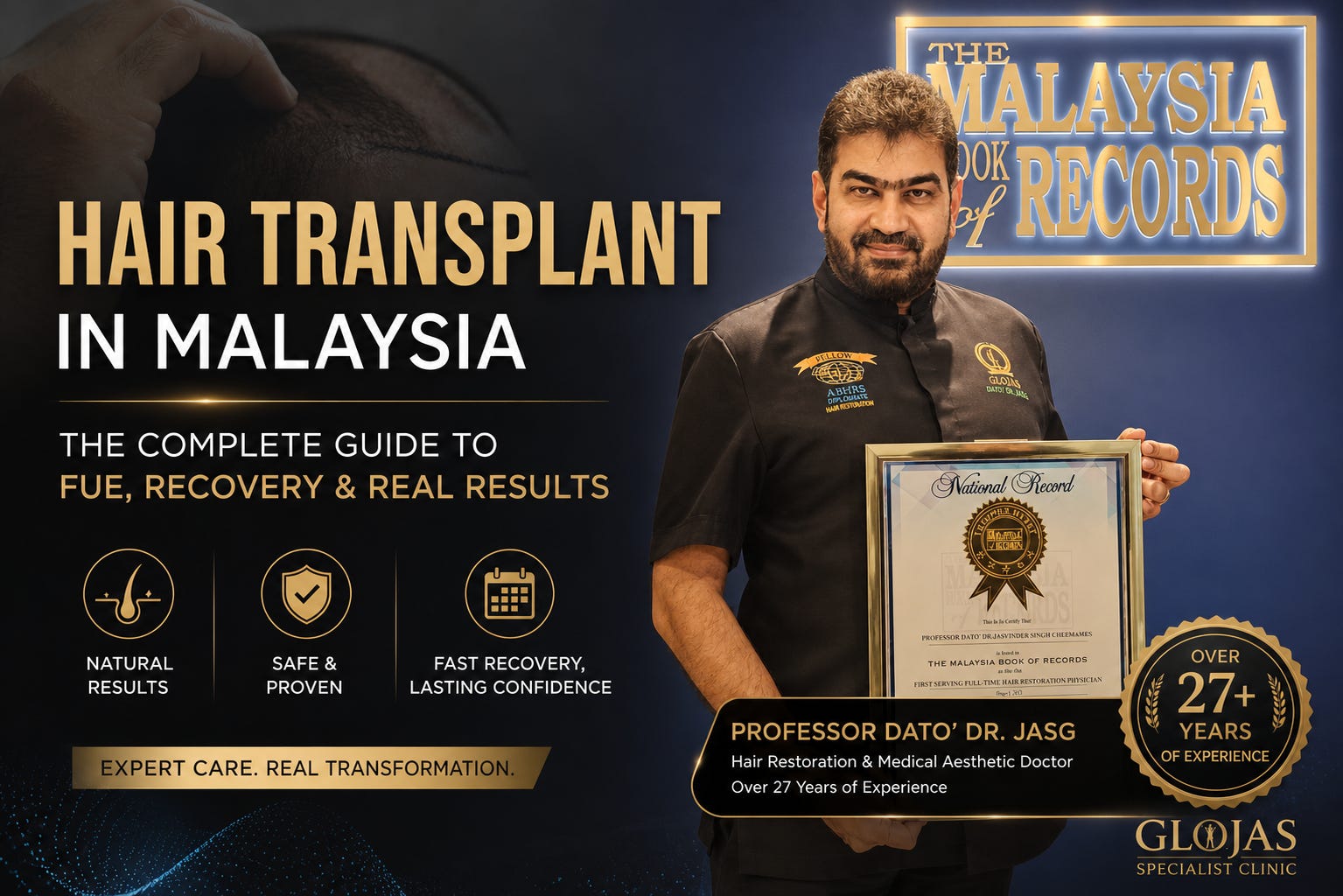
Professor Dato’ Dr. JasG is a leading medical aesthetic physician and hair transplant surgeon based in Kuala Lumpur, and the founder of GLOJAS Specialist Clinic. With over 27 years of experience, he is widely recognized for his precision, safety standards, and consistently natural-looking results.
He holds a distinguished range of international and Malaysian credentials, including Fellow of the International Society of Hair Restoration Surgery (FISHRS), Diplomate of the American Board of Hair Restoration Surgery (ABHRS), LCP certification from the Ministry of Health Malaysia (MOH), and a Diplomate in Aesthetic Medicine (USA).
As a pioneer of hair restoration in Malaysia, Dr. JasG developed the SMART™ Hair Transplant technique (SMART FUE, SMART FUT, and SMART PRP), designed to enhance graft precision, patient comfort, and recovery outcomes.
He currently serves as President of the Malaysian Hair Restoration Society (MHRS), has received multiple international awards, and has been rated 8.8/10 by MediHair as the No.1 Hair Transplant Doctor in Malaysia. He also serves as an advisor to various organizations, including Miss Malaysia Universe.